
Why Accounting Firms Are Prime Targets for Cybercriminals
Accounting firms manage some of the most valuable data a criminal can steal.
Your systems may contain:
- Social Security numbers
- Tax returns
- Payroll records
- Banking information
- Business financial statements
- Personally Identifiable Information (PII)
- Client login credentials
Criminals know accounting firms operate under strict deadlines. During tax season, every hour of downtime can mean missed filings, delayed client work, lost revenue, and reputational damage.
That urgency makes accounting firms attractive targets for ransomware groups and phishing campaigns.
The good news? Most successful attacks exploit common security weaknesses that can be addressed with a proactive cybersecurity strategy.
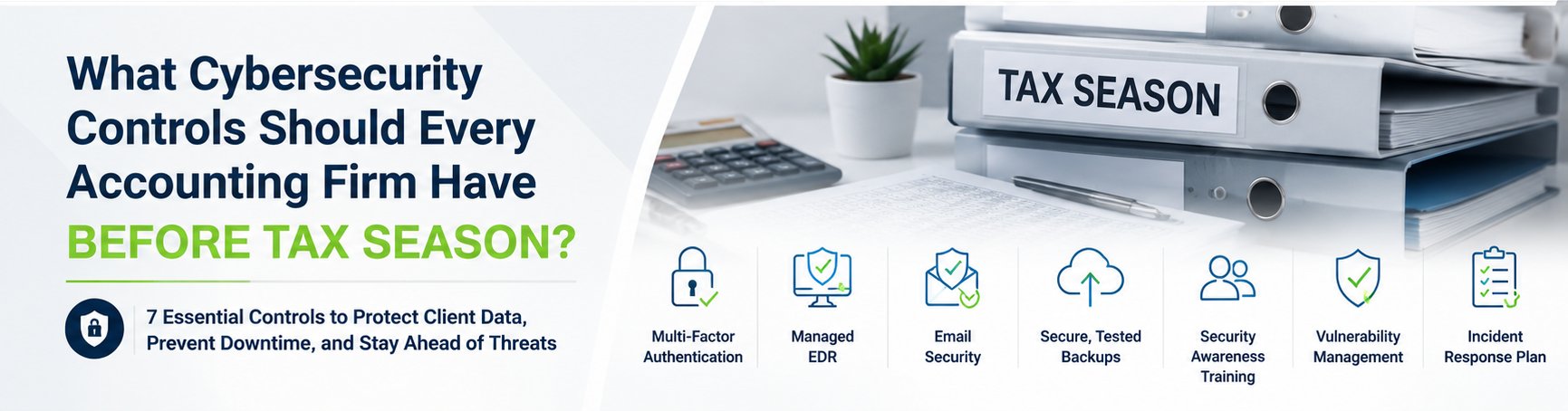
The 7 Essential Cybersecurity Controls Every Accounting Firm Needs
1. Multi-Factor Authentication (MFA)
Passwords alone are no longer enough.
Even strong passwords can be compromised through phishing, malware, or password reuse.
Enable MFA for every system that supports it, including:
- Microsoft 365
- Email accounts
- VPN access
- Remote desktop
- Accounting software
- Password managers
- Cloud storage
A stolen password should never be enough to access sensitive client information.
2. Managed Endpoint Detection & Response (EDR)
Traditional antivirus software focuses on known threats.
Modern attacks evolve too quickly for signature-based protection alone.
Managed EDR continuously monitors workstations and servers for suspicious activity, including:
- Ransomware behavior
- Credential theft
- Malicious PowerShell activity
- Lateral movement
- Unauthorized software execution
When suspicious behavior is detected, managed EDR can isolate an affected device before the attack spreads throughout the network.
3. Advanced Email Security
Email remains the most common entry point for cyberattacks.
Accounting firms should implement:
- Anti-phishing protection
- Safe attachment scanning
- Safe link protection
- SPF
- DKIM
- DMARC
- Executive impersonation detection
- Business email compromise protection
These technologies significantly reduce the likelihood that malicious emails ever reach employees' inboxes.
4. Secure, Tested Backups
Having backups isn't enough.
The real question is:
Can you recover your business quickly if disaster strikes?
Every accounting firm should follow the 3-2-1 backup strategy:
- Three copies of your data
- Stored on two different media types
- With one copy kept off-site or immutable
Just as importantly, backups should be tested regularly to verify they can actually be restored.
Recovery planning is often the difference between a temporary disruption and a prolonged business outage.
5. Employee Security Awareness Training
Technology alone cannot stop every attack.
Employees remain one of the most important layers of defense.
Regular training should cover:
- Phishing emails
- Social engineering
- Fake Microsoft login pages
- QR code scams
- Wire transfer fraud
- Password best practices
- Secure handling of client information
Many organizations also conduct phishing simulations to reinforce training with real-world scenarios.
6. Vulnerability and Patch Management
Cybercriminals frequently exploit known software vulnerabilities that organizations simply haven't patched.
A proactive vulnerability management program includes:
- Operating system updates
- Microsoft 365 security reviews
- Third-party application updates
- Firmware updates
- Regular vulnerability scanning
- Configuration reviews
Waiting until something breaks is no longer an acceptable security strategy.
7. An Incident Response Plan
Every accounting firm should know exactly what happens if a cybersecurity incident occurs.
Your response plan should answer questions such as:
- Who is responsible for responding?
- How are infected systems isolated?
- How are clients informed?
- How are backups restored?
- What regulatory notifications may be required?
- How quickly can business operations resume?
Having a documented plan dramatically reduces confusion during an emergency.
Common Cybersecurity Mistakes We See
Many accounting firms believe they're protected because they have antivirus software and backups.
Unfortunately, attackers look for much more than that.
Common weaknesses include:
- No multi-factor authentication
- Shared user accounts
- Local-only backups
- Unsupported operating systems
- Employees with local administrator privileges
- Weak Microsoft 365 security settings
- No security awareness training
- No proactive monitoring
Addressing these issues often provides far greater protection than purchasing another security product.
A Tax Season Cybersecurity Checklist
Before tax season begins, every accounting firm should verify the following:
- Multi-factor authentication enabled for all users
- Managed EDR installed on every workstation and server
- Microsoft 365 security settings reviewed
- Backups tested successfully
- Disaster recovery procedures documented
- Security awareness training completed
- Critical systems fully patched
- Password policies updated
- Administrative accounts reviewed
- Cyber insurance requirements verified
Completing this checklist significantly improves your organization's security posture before the busiest time of the year.
How Everleap IT Helps Accounting Firms Stay Secure
Cybersecurity is most effective when it's proactive.
At Everleap IT, we don't simply respond to support requests. We help clients reduce risk before problems occur. Visit Everleap IT to learn more.
Our approach is shaped by more than 20 years managing and securing production hosting environments, where uptime, security, and continuous monitoring are critical every day.
That operational experience influences everything we do, including:
- Continuous infrastructure monitoring
- Proactive vulnerability management
- Secure Microsoft 365 administration
- Managed endpoint security
- Backup verification
- Strategic IT planning
- Compliance-aware technology recommendations
Rather than waiting for systems to fail, we help clients build secure, resilient technology environments designed to support long-term business success.
Cybersecurity Is an Ongoing Process, Not a One-Time Project
Cyber threats evolve constantly.
Protecting an accounting firm requires more than installing software or responding to help desk tickets. It requires continuous monitoring, disciplined operations, strategic planning, and a security-first mindset.
For more than 20 years, Everleap IT has protected production hosting environments where reliability and security are mission-critical. Today, we bring that same operational discipline to accounting and financial firms throughout the Inland Empire, including Rancho Cucamonga, Ontario, Chino, Claremont, and nearby communities.
If you're preparing for tax season or evaluating your firm's cybersecurity posture, now is the ideal time to review your technology environment before a cybercriminal does. You can book a 15 minute meeting if you have any questions on how to start.