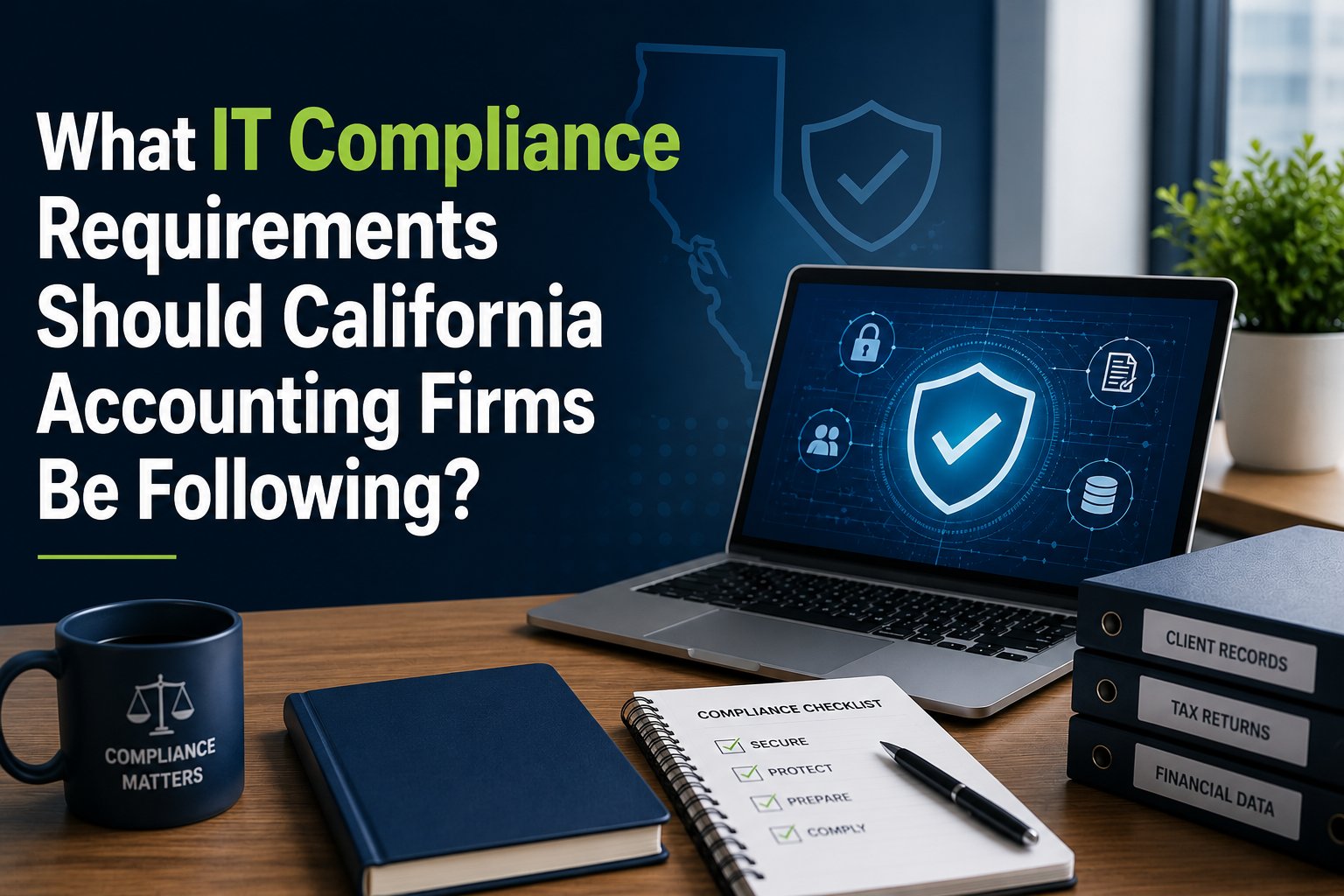
Accounting firms are trusted with some of the most sensitive information a business can possess, including tax returns, payroll records, financial statements, banking information, and personally identifiable information (PII). As cyber threats continue to increase, protecting that data is no longer just a best practice. It is a business necessity.
Depending on the clients you serve and the services you provide, your firm may need to address technology requirements from the FTC Safeguards Rule, IRS Publication 4557, the Gramm-Leach-Bliley Act (GLBA), California privacy laws, cyber insurance providers, and client contractual obligations. While these regulations differ in scope, they all emphasize the same core principles: protect sensitive data, manage cybersecurity risks, and prepare for potential incidents.
The good news is that compliance does not require dozens of disconnected tools. Most accounting firms can significantly improve their security posture by implementing six foundational technology controls. In this guide, we'll explain what those controls are, where firms commonly fall short, and how a proactive IT strategy can help reduce risk while supporting compliance efforts.
Why Compliance Matters for Accounting Firms
Every accounting firm is a target for cybercriminals. Whether you have five employees or fifty, attackers know your systems likely contain Social Security numbers, tax returns, payroll data, banking information, and confidential financial records.
A successful cyberattack can result in:
- Business interruption during tax season
- Loss of sensitive client information
- Regulatory investigations
- Increased cyber insurance premiums
- Damage to your firm's reputation
- Loss of client trust
Strong cybersecurity practices help reduce these risks while demonstrating to clients that their financial information is being protected responsibly.
The Six Technology Controls Every Accounting Firm Should Review
While every firm's compliance obligations are unique, these six areas provide a practical framework for strengthening your technology environment.
1. Secure User Access
Your users are the gateway to your firm's systems. Access should be granted based on business need and reviewed regularly.
Best practices include:
- Unique user accounts for every employee
- Role-based permissions
- Strong password policies
- Password manager deployment
- Immediate removal of former employee access
- Administrative accounts separated from standard user accounts
Reducing unnecessary access limits the damage that can occur if an account is compromised.
2. Multi-Factor Authentication (MFA)
Passwords alone are no longer enough.
Multi-Factor Authentication requires users to verify their identity using an additional factor, such as a mobile app or security key, before accessing business systems.
MFA should be enabled for:
- Microsoft 365
- Remote access
- Accounting software
- Cloud applications
- Administrative accounts
According to Microsoft, MFA blocks the vast majority of automated password-based attacks, making it one of the highest-impact security improvements a business can implement.
3. Data Encryption
Encryption protects sensitive information if a device is lost, stolen, or intercepted.
Accounting firms should consider encryption for:
- Laptop hard drives
- Mobile devices
- Cloud storage
- Email containing sensitive information
- Backup data
Encryption helps ensure that even if someone gains physical access to a device, the data remains unreadable without proper authorization.
4. Backup and Disaster Recovery
Backups are essential, but successful recovery is what truly matters.
A comprehensive backup strategy should include:
- Automated daily backups
- Multiple backup copies
- Off-site or cloud-based storage
- Immutable backup options where appropriate
- Regular restore testing
- Documented recovery procedures
Many organizations discover problems with their backups only after a disaster occurs. Regular testing confirms that your data can actually be restored when needed.
5. Employee Security Awareness Training
Technology alone cannot stop every cyberattack.
Employees should receive ongoing training on topics such as:
- Phishing emails
- Business email compromise
- Password security
- Safe web browsing
- Data handling procedures
- Social engineering attacks
Even short quarterly training sessions can significantly reduce human error, which remains one of the leading causes of cybersecurity incidents.
6. Documentation and Security Policies
Good documentation creates consistency and supports business continuity.
Important documentation includes:
- Network diagrams
- Hardware inventory
- Software inventory
- Vendor contact information
- Backup procedures
- Incident response plan
- Acceptable use policy
- Password policy
- Employee onboarding and offboarding procedures
Well-maintained documentation also makes onboarding new employees and working with outside vendors much more efficient.
Common Compliance Gaps We See
Many accounting firms already have security tools in place, but there are often gaps that increase overall risk.
Some of the most common issues include:
- Shared user accounts
- Multi-Factor Authentication enabled for only some users
- Unsupported Windows versions
- Local administrator rights assigned to all employees
- Backups that have never been tested
- Missing endpoint protection
- No documented incident response plan
- Employees who have never received cybersecurity training
- Inconsistent patch management
- Lack of regular security reviews
Individually, these issues may seem minor. Together, they can create opportunities for attackers to compromise sensitive systems.
An Annual Technology Compliance Checklist
Every accounting firm should perform a structured technology review at least once each year.
Use this checklist as a starting point:
| Review Item | Complete? |
|---|---|
| Multi-Factor Authentication enabled for all users | ☐ |
| Employee access reviewed | ☐ |
| Password policies updated | ☐ |
| Microsoft 365 security settings reviewed | ☐ |
| Operating systems fully patched | ☐ |
| Endpoint protection verified | ☐ |
| Backup restores successfully tested | ☐ |
| Disaster recovery plan reviewed | ☐ |
| Security awareness training completed | ☐ |
| Hardware inventory updated | ☐ |
| Vendor access reviewed | ☐ |
| Cyber insurance requirements reviewed | ☐ |
Completing an annual review helps identify gaps before they become larger security issues.
Compliance Is an Ongoing Process
Compliance is not something you complete once and forget.
Technology changes. Employees come and go. New threats emerge. Software vendors release updates. Regulations evolve.
The firms that maintain strong security are those that continuously evaluate and improve their technology environment.
Maintaining compliance also requires ongoing investment in your technology environment. The good news is that for most small and midsized accounting firms, improving security and compliance is often more affordable than expected when approached strategically.
If you're wondering what a proactive managed IT relationship typically costs, see our guide on How Much Does Managed IT Cost for a 5-25 Employee Accounting Firm in California?
How Everleap IT Helps Accounting Firms Strengthen Their Security Posture
At Everleap IT, we understand that accounting firms need more than someone to fix computers when they break.
Our team helps clients build secure, reliable technology environments by focusing on proactive planning, cybersecurity, and operational excellence.
Our managed IT cybersecurity services include:
- Continuous monitoring
- Security-focused Microsoft 365 management
- Endpoint protection
- Backup verification
- Patch management
- Strategic IT planning
- Infrastructure documentation
- Regular technology reviews
- Compliance-aware technology recommendations
Our experience managing production hosting environments for more than 20 years has shaped the disciplined operational approach we bring to every client engagement.
Build a Stronger Foundation for Compliance
Technology compliance isn't about checking boxes. It's about creating systems and processes that protect your clients, support your employees, and reduce business risk.
By focusing on secure access, Multi-Factor Authentication, encryption, backup and recovery, employee training, and ongoing documentation, accounting firms can make meaningful progress toward a stronger security posture.
We help accounting firms build secure, well-documented technology environments that support compliance initiatives and reduce operational risk. Our role is to implement and maintain the technical controls that help organizations meet their security and compliance objectives.
If you're unsure whether your current technology environment supports your compliance goals, a proactive IT assessment can identify opportunities for improvement before they become costly problems.
If you're also comparing providers or trying to budget for managed IT services, our pricing guide explains the factors that influence cost for accounting firms and what services are typically included.
Ready to Strengthen Your Firm's Security?
Everleap IT helps implement secure, reliable technology that supports business growth and reduces operational risk for accounting firms throughout California's Inland Empire, including Ontario, Rancho Cucamonga, Upland, Claremont, and nearby communities.
If you'd like an objective review of your current IT environment, contact us to schedule a technology assessment and discover where improvements can have the greatest impact.