
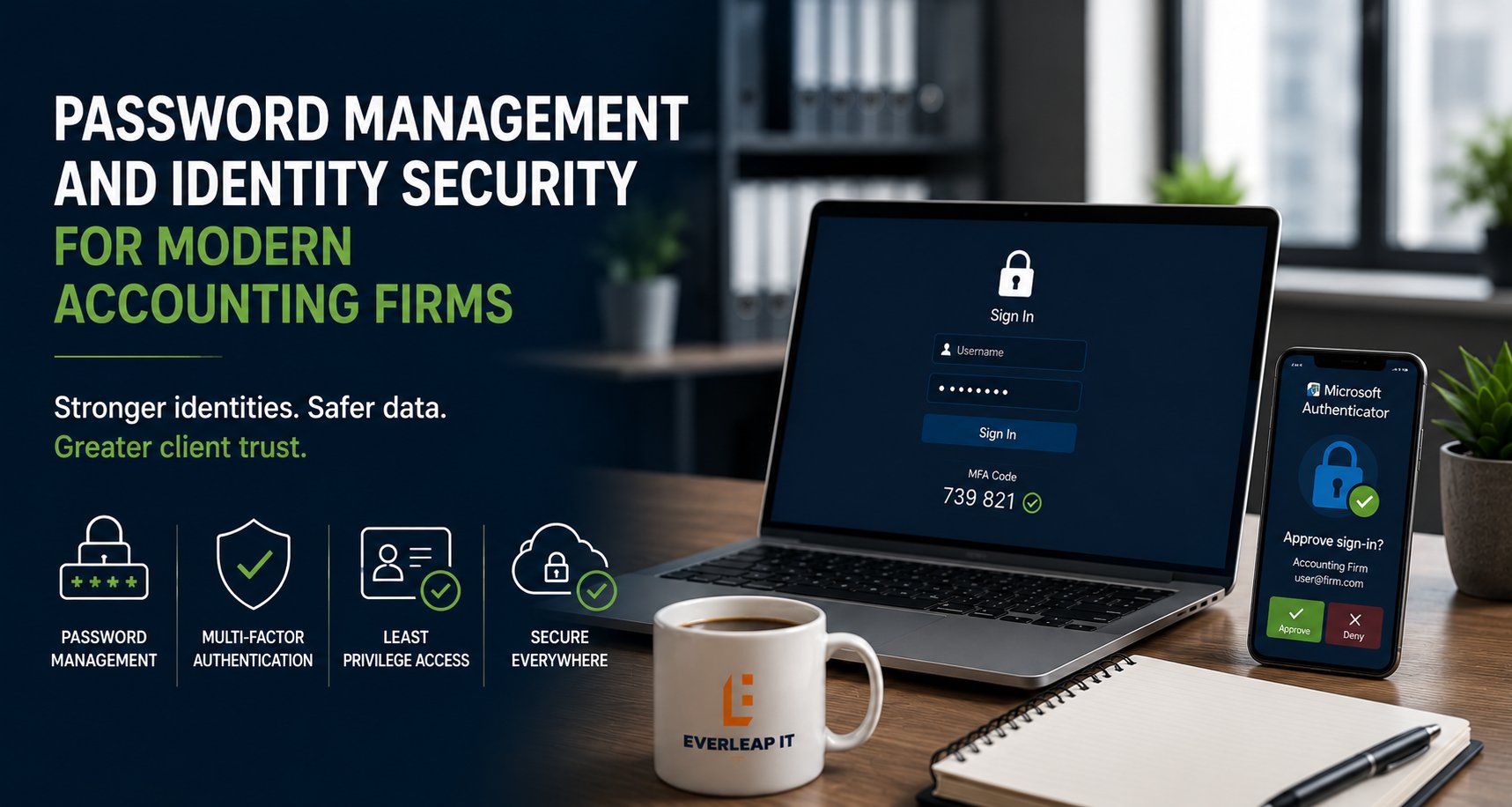
Why Identity Security Matters More Than Ever
Cyberattacks have changed dramatically over the past decade.
Rather than attempting to break through firewalls, many attackers simply log in using stolen credentials.
These credentials are often obtained through:
- Phishing emails
- Password reuse
- Data breaches
- Social engineering
- Malware
- Weak password practices
If an attacker successfully logs in with legitimate credentials, traditional security tools may not immediately recognize the activity as suspicious.
Protecting user identities has become one of the most important components of a layered cybersecurity strategy. Identity protection works alongside other foundational cybersecurity controls, including endpoint protection, email security, vulnerability management, backup verification, and employee security awareness training.
Passwords Alone Are No Longer Enough
For many years, organizations relied almost entirely on password complexity requirements.
Employees were instructed to create long passwords containing uppercase letters, lowercase letters, numbers, and symbols.
While strong passwords remain important, passwords alone cannot adequately protect today’s business environments.
Instead, organizations should focus on multiple layers of identity protection.
Common Password Mistakes We Still See
Many security incidents begin with simple mistakes.
Examples include:
- Reusing the same password across multiple systems
- Sharing passwords between employees
- Storing passwords in spreadsheets
- Writing passwords on sticky notes
- Saving passwords in unsecured documents
- Using predictable passwords based on company names or seasons
These practices make it significantly easier for attackers to compromise business accounts.
Password Managers Improve Both Security and Productivity
One of the most effective improvements an accounting firm can make is implementing a business password manager.
Password managers allow employees to:
- Generate unique passwords
- Store credentials securely
- Share passwords safely when appropriate
- Access passwords across multiple devices
- Reduce password reset requests
Rather than asking employees to remember dozens of complex passwords, password managers make strong security easier to maintain.
For business environments, password managers also provide administrative oversight and secure credential sharing when employees change roles or leave the organization.
Multi-Factor Authentication Is Essential
Even strong passwords can be stolen.
Multi-Factor Authentication adds another layer of protection by requiring users to verify their identity using something they know and something they possess.
Examples include:
- Microsoft Authenticator
- Authenticator applications
- Hardware security keys
- Passkeys
- Biometric authentication
MFA should be enabled for every business system that supports it, including:
- Microsoft 365
- VPN access
- Accounting software
- Password managers
- Remote access solutions
For most organizations, MFA provides one of the highest returns on investment of any cybersecurity initiative.
Identity Security Goes Beyond Passwords
Modern identity management focuses on controlling who has access to business systems and ensuring that access remains appropriate over time.
A comprehensive identity security strategy includes:
Least Privilege Access
Employees should receive only the permissions necessary to perform their jobs.
Reducing unnecessary administrative privileges limits the impact of compromised accounts.
User Lifecycle Management
Every accounting firm should have documented procedures for:
- New employee onboarding
- Role changes
- Employee departures
- Temporary access
- Vendor access
Promptly removing unnecessary accounts reduces long-term security risk.
Conditional Access
Conditional Access allows organizations to apply intelligent security policies based on user behavior and device health.
Examples include:
- Requiring MFA when users sign in remotely
- Blocking access from unfamiliar countries
- Restricting access from unmanaged devices
- Requiring compliant devices before granting access
These policies strengthen security while minimizing unnecessary disruption for employees.
For firms using Microsoft 365, the security and identity capabilities available to the organization also depend on its licensing. Understanding the differences between Microsoft 365 Business Standard and Business Premium can help firms determine which identity, device management, and security capabilities are available within their environment.
Identity Monitoring
Organizations should monitor for:
- Unusual login locations
- Repeated failed login attempts
- Impossible travel events
- Privileged account changes
- Suspicious authentication activity
Early detection often prevents larger security incidents.
Preparing for a Passwordless Future
Microsoft and other technology providers continue moving toward passwordless authentication.
Technologies such as:
- Passkeys
- Windows Hello for Business
- Microsoft Authenticator
- Hardware security keys
reduce dependence on traditional passwords while improving both security and user experience.
Although passwords will remain part of many environments for years to come, organizations should begin planning for more modern identity strategies. These changes do not necessarily need to happen at once. Identity modernization can become part of a firm’s broader three-year IT roadmap, allowing leadership to prioritize security improvements alongside hardware, cloud, infrastructure, and other technology investments.
Identity Security Supports Production Readiness
Identity security is one of the core pillars of a Production Ready technology environment.
Unauthorized access can disrupt operations just as quickly as hardware failures or network outages.
Protecting user identities helps ensure employees can continue working securely while reducing the likelihood of ransomware, business email compromise, and unauthorized access to client information.
Our article Is Your Accounting Firm Production Ready for Tax Season? explains how identity security fits into a broader operational readiness strategy that also includes infrastructure health, monitoring, recovery planning, documentation, and strategic technology planning.
How Everleap IT Helps Accounting Firms Strengthen Identity Security
At Everleap IT, identity security is integrated into every technology environment we manage.
Our services include:
- Multi-Factor Authentication deployment
- Microsoft Entra ID configuration
- Conditional Access implementation
- Password manager deployment
- Identity monitoring
- User lifecycle management
- Administrative account reviews
- Microsoft 365 security optimization
- Strategic security planning
Our goal is not simply to improve passwords.
We help clients develop identity security strategies that reduce operational risk while supporting long-term business resilience.
Identity Security Is About More Than Passwords
Strong passwords remain important.
However, modern cybersecurity requires a broader approach that combines identity management, authentication, monitoring, and user education.
Accounting firms that invest in identity security reduce cyber risk, strengthen operational resilience, improve compliance readiness, and better protect the sensitive financial information their clients trust them to safeguard.
Protecting identities is no longer just a technical requirement.
It is a business responsibility.
Ready to Strengthen Your Identity Security?
Everleap IT helps accounting firms throughout California’s Inland Empire, including Claremont, Ontario, Rancho Cucamonga, Upland and nearby communities, protect user identities through Microsoft Entra ID, Multi-Factor Authentication, Conditional Access, password management, and Microsoft 365 security optimization.
If you’d like to better understand how identity security fits into your overall technology strategy, schedule an Identity Security Assessment. We’ll evaluate your current environment, identify opportunities to reduce risk, and help you build a more secure and resilient identity management strategy. You can always contact us to discuss your IT situation and schedule an assessment.