
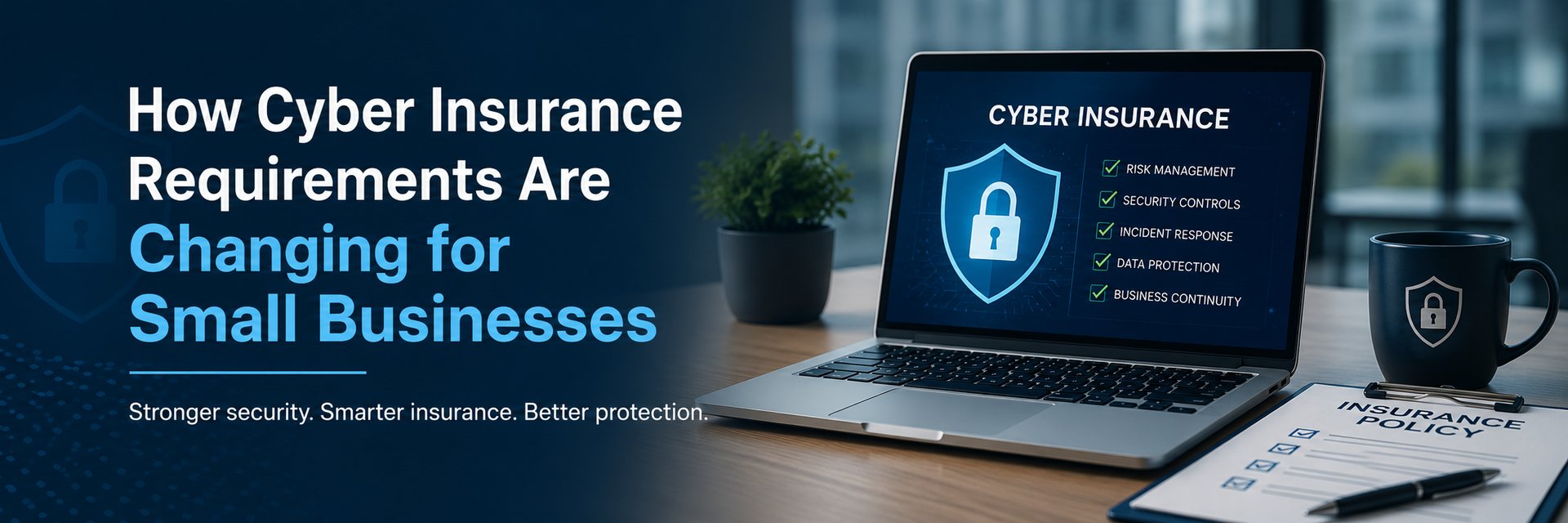
Cyber insurance has become an important part of many organizations’ risk management strategies. For accounting firms, financial services organizations, and other businesses that handle sensitive information, cyber insurance can help reduce the financial impact of ransomware, data breaches, business email compromise, and other cyber incidents.
At the same time, obtaining or renewing cyber insurance has become more challenging.
Insurance providers are asking more detailed questions about cybersecurity than they did just a few years ago. Many organizations are discovering that having antivirus software and regular backups is no longer enough. Insurers increasingly want evidence that businesses have implemented layered security controls and actively manage cyber risk.
While every insurance carrier has its own underwriting requirements, one trend is clear: organizations that invest in strong cybersecurity practices are generally better prepared for both cyber threats and insurance renewals.
Why Cyber Insurance Requirements Are Becoming More Demanding
Cybercrime has changed dramatically over the past decade.
Ransomware attacks have become more sophisticated. Business email compromise continues to cause billions of dollars in losses. Attackers increasingly target small and midsized businesses because they often have valuable data but fewer security resources than larger enterprises.
As claims have increased, insurance carriers have responded by placing greater emphasis on risk reduction before issuing or renewing policies.
Rather than simply transferring risk through insurance, organizations are expected to demonstrate that they are actively managing cybersecurity within their business. For California accounting firms, many of these same security practices also support broader compliance obligations and client security expectations.
For business owners, this is ultimately a positive development. The same security improvements that support cyber insurance also reduce the likelihood of experiencing a costly cyber incident.
Cyber Insurance Starts with Good Security
One common misconception is that cyber insurance creates security.
It doesn’t.
Insurance helps businesses recover financially after an incident, but it cannot prevent ransomware, stop phishing attacks, or restore employee productivity during an outage. That's why organizations benefit from taking a proactive approach to cybersecurity rather than relying on insurance alone.
Effective cybersecurity always begins with prevention.
Organizations should view cyber insurance as one component of a broader risk management strategy that also includes proactive security controls, employee awareness, business continuity planning, and ongoing technology management. For accounting firms, these foundational safeguards become especially important before tax season when cyber threats tend to increase.
Security Controls Commonly Evaluated During Cyber Insurance Renewals
While specific requirements vary between carriers and policies, there are several security practices that insurers frequently ask organizations to document.
Multi-Factor Authentication (MFA)
Multi-Factor Authentication remains one of the most effective ways to protect user accounts.
Many insurers expect MFA to be enabled for:
- Microsoft 365
- Remote access
- Administrative accounts
- Cloud applications
- Email systems
Because compromised credentials remain one of the leading causes of cyber incidents, strong authentication is often considered foundational.
Endpoint Detection and Response (EDR)
Traditional antivirus software focuses on known threats.
Modern Endpoint Detection and Response solutions monitor devices for suspicious behavior, helping organizations identify and respond to attacks before they spread throughout the network.
For firms handling confidential financial information, advanced endpoint protection significantly improves overall resilience.
Email Security
Email continues to be one of the most common entry points for cyberattacks.
Organizations should implement protections such as:
- Advanced spam filtering
- Malware scanning
- Safe attachment analysis
- Phishing protection
- Domain authentication technologies such as SPF, DKIM, and DMARC
Reducing phishing risk protects both employees and clients.
Backup and Disaster Recovery
Backups remain one of the most important safeguards against ransomware.
However, insurers increasingly recognize that backups are only effective if they can actually be restored.
Organizations should regularly:
- Verify backup completion
- Perform restore testing
- Maintain multiple backup copies
- Store backups separately from production systems
- Document recovery procedures
A successful recovery strategy minimizes downtime and supports business continuity.
Security Awareness Training
Technology alone cannot eliminate cyber risk.
Employees should understand how to recognize:
- Phishing emails
- Business email compromise
- Social engineering
- Suspicious links
- Credential theft attempts
Ongoing security awareness training helps reduce one of the largest sources of cybersecurity incidents: human error.
Patch Management
Attackers frequently exploit known software vulnerabilities that have already been patched by vendors.
Maintaining current operating systems, applications, and firmware reduces unnecessary exposure and demonstrates a proactive approach to security.
Incident Response Planning
Every organization should assume that a security incident is possible.
An incident response plan helps answer important questions before an emergency occurs:
- Who should be contacted?
- Which systems are most critical?
- How will employees communicate?
- How will clients be notified if necessary?
- What steps should be taken to contain an incident?
Preparation often reduces both business disruption and recovery time.
Common Challenges Businesses Face During Renewal
Many organizations are surprised by the level of detail requested during cyber insurance renewals.
Some of the most common gaps include:
- Multi-Factor Authentication enabled for only some users
- Unsupported operating systems
- Weak password policies
- Unverified backups
- Inconsistent security documentation
- Limited employee security training
- Lack of documented incident response procedures
These issues don’t necessarily prevent coverage, but they often highlight opportunities to improve an organization’s overall security posture.
Preparing for Your Next Cyber Insurance Renewal
The best time to prepare for renewal is months before your policy expires.
A proactive review gives your organization time to strengthen security controls and address any weaknesses before completing insurer questionnaires.
Consider reviewing:
- User authentication policies
- Endpoint protection
- Backup verification
- Employee security training
- Device inventory
- Administrative privileges
- Vendor access
- Patch management
- Disaster recovery procedures
- Security documentation
Even if your insurance carrier never asks about a particular control, implementing these practices improves your organization's resilience. If you're reviewing your firm's overall technology environment, our Complete IT Checklist for Starting or Growing a CPA Firm provides a broader planning framework beyond cyber insurance alone.
Many organizations discover that implementing these controls is easier when they have ongoing IT management rather than trying to address everything just before renewal. If you're evaluating outside IT support, it's also helpful to understand what managed IT services typically cost for accounting firms.
Cyber Insurance Is About More Than Passing a Questionnaire
Organizations sometimes focus on completing insurance applications instead of improving cybersecurity.
That’s the wrong objective.
The real goal should be reducing the likelihood and impact of cyber incidents.
Businesses with mature cybersecurity practices often find insurance renewals easier because they have already implemented the controls insurers commonly evaluate.
Rather than chasing annual requirements, they continuously strengthen their security throughout the year.
How Everleap IT Helps Clients Build a Stronger Security Posture
At Everleap IT, we help accounting firms and small businesses strengthen the technology foundation that supports long-term security and risk management. Our managed IT approach for accounting firms focuses on reducing operational risk while improving reliability, compliance readiness, and cybersecurity.
Our services include:
- Security assessments
- Multi-Factor Authentication deployment
- Microsoft 365 security optimization
- Endpoint Detection and Response
- Continuous monitoring
- Backup verification
- Patch management
- Infrastructure documentation
- Strategic technology planning
- Security awareness guidance
Our objective is not simply to help clients prepare for insurance renewals. It’s to help them build secure, resilient technology environments that reduce operational risk and support long-term business success.
Organizations with stronger cybersecurity practices are often better positioned when completing cyber insurance applications because the underlying security controls are already in place.
Build Security First. Insurance Benefits Follow.
Cyber insurance remains an important part of modern business risk management, but it should never replace a comprehensive cybersecurity strategy.
Organizations that continuously improve authentication, endpoint protection, employee awareness, backup practices, and operational security are better prepared to defend against cyber threats while also supporting cyber insurance requirements.
Instead of asking, “What do we need to pass our insurance renewal?” consider asking, “What can we do to better protect our business?”
The answer to the second question often makes the first one much easier.
Ready to Strengthen Your Security Posture?
Everleap IT helps reduce cybersecurity risk through proactive managed IT, Microsoft 365 security, endpoint protection, strategic planning, and ongoing technology management for accounting firms, financial services organizations, and small businesses throughout California’s Inland Empire, including Rancho Cucamonga, Upland, Ontario, Chino Hills, Claremont, and nearby communities.
If you’d like an objective assessment of your current cybersecurity posture before your next insurance renewal, we’d be happy to help identify practical improvements that support both your business and your long-term risk management strategy. Book an appointment to discuss your IT situation today.