
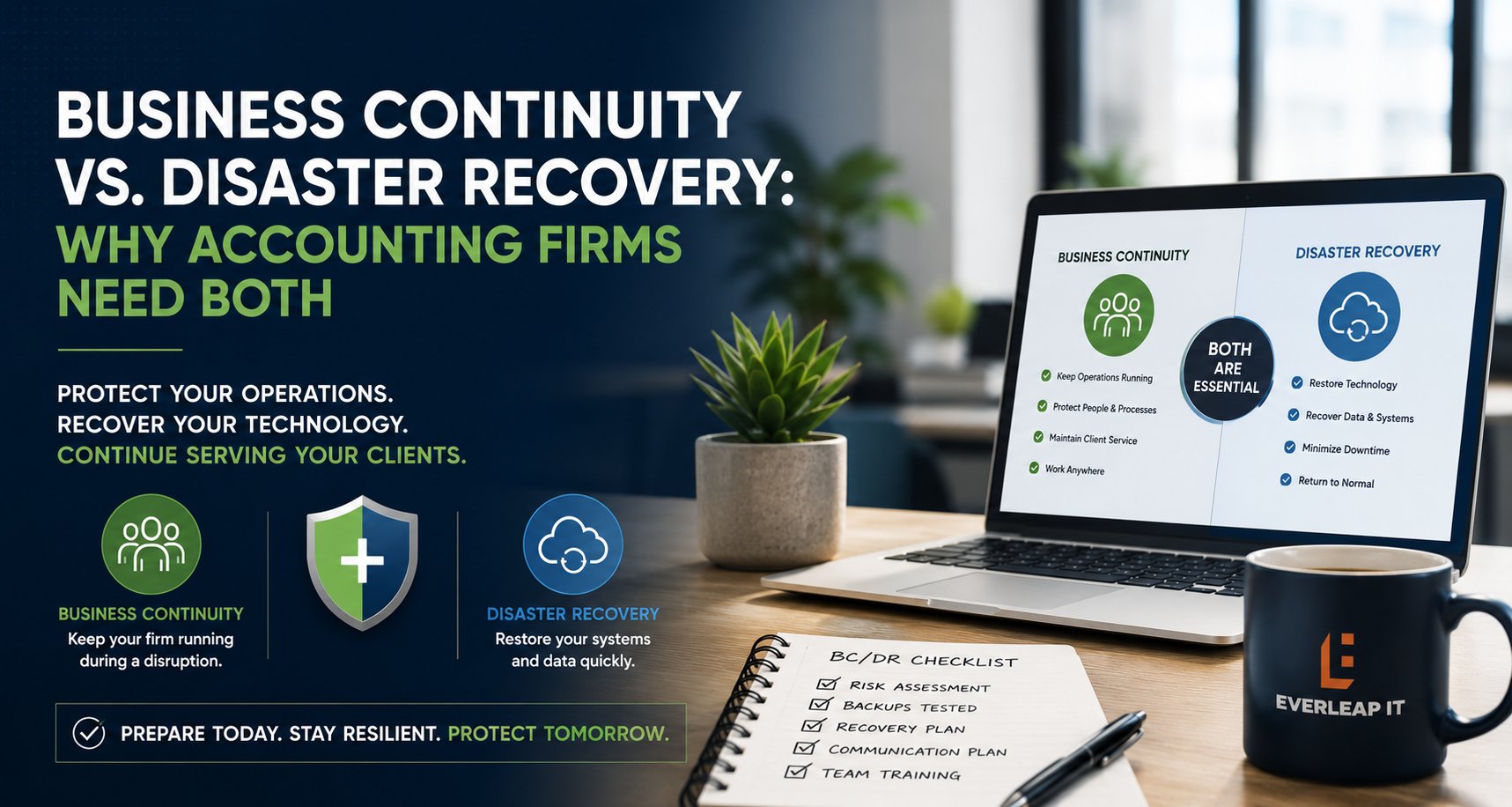
For most accounting firms, technology is the foundation of daily operations. Tax preparation software, document management systems, Microsoft 365, client portals, payroll applications, and financial data all need to be available when your team is serving clients.
When something goes wrong, whether it’s a ransomware attack, a hardware failure, an internet outage, or a natural disaster, many business owners immediately ask one question:
“Can we restore our backups?”
While backups are essential, they are only one piece of the puzzle.
A backup helps recover your data.
A disaster recovery plan helps restore your technology.
A business continuity plan helps your firm continue serving clients while recovery is taking place.
Understanding the difference between these concepts is one of the most important steps an accounting firm can take to reduce operational risk and prepare for unexpected events.
Why This Matters for Accounting Firms
Accounting firms operate under deadlines that cannot easily be moved.
Whether it’s tax season, payroll processing, quarterly filings, or year-end reporting, extended downtime affects more than technology.
It can impact:
- Client service
- Employee productivity
- Revenue
- Regulatory deadlines
- Business reputation
- Client confidence
The objective is not simply to recover from an incident.
The objective is to continue operating with as little disruption as possible.
That requires both business continuity and disaster recovery.
What Is Business Continuity?
Business continuity is your firm’s ability to continue operating during and immediately after a disruption.
The focus is on keeping critical business functions running.
Questions a business continuity plan should answer include:
- How will employees continue working?
- Can staff work remotely if the office is unavailable?
- How will clients communicate with the firm?
- Which business functions are most critical?
- Who makes operational decisions during an emergency?
- How will vendors be contacted?
Business continuity is about maintaining operations, even if technology is temporarily unavailable.
What Is Disaster Recovery?
Disaster recovery focuses specifically on restoring technology systems after an outage or disaster.
A disaster recovery plan typically addresses:
- Server restoration
- Cloud service recovery
- Backup restoration
- Network recovery
- Internet connectivity
- Hardware replacement
- Microsoft 365 recovery procedures
- Application restoration
Disaster recovery answers the question:
“How do we restore our technology?”
Business continuity answers:
“How do we continue serving clients while that happens?”
Both are essential.
Common Events Every Accounting Firm Should Plan For
Business interruptions rarely happen exactly as expected.
Some of the most common scenarios include:
Cybersecurity Incidents
Examples include:
- Ransomware
- Business email compromise
- Phishing attacks
- Credential theft
Strong cybersecurity reduces risk, but every organization should still prepare for the possibility of an incident.
For guidance on foundational protections, see our article What Cybersecurity Controls Should Every Accounting Firm Have Before Tax Season?
Hardware Failure
Servers, firewalls, storage devices, and laptops eventually fail.
Without planning, replacing critical hardware can create unnecessary downtime.
A proactive hardware lifecycle strategy significantly reduces this risk.
If your firm is evaluating aging infrastructure, our guide How Often Should Accounting Firms Replace Computers and Servers? explains how to plan hardware refreshes before failures occur.
Internet or Cloud Service Outages
Even cloud-based businesses depend on reliable internet connectivity.
Organizations should consider:
- Internet redundancy
- Mobile hotspot procedures
- Alternate work locations
- Offline workflows where practical
Cloud services improve resilience but do not eliminate operational planning.
Our article Should Your Accounting Firm Move to the Cloud? A Practical Decision Framework discusses how cloud strategy fits into long-term business planning.
Human Error
Not every incident involves sophisticated cybercriminals.
Employees may accidentally:
- Delete files
- Misconfigure systems
- Send sensitive information to the wrong recipient
- Fall victim to phishing attacks
Documented procedures and employee training help reduce these risks.
Natural Disasters
Power outages, severe weather, fires, flooding, and building access issues can all affect business operations.
Even firms with cloud infrastructure should have plans for maintaining communication and employee productivity during these events.
The Essential Components of a Business Continuity Plan
Every accounting firm should develop a written plan that addresses the following areas.
Business Impact Analysis
Identify the business processes that are most critical.
Examples include:
- Tax preparation
- Payroll processing
- Client communications
- Document management
- Financial reporting
Understanding priorities helps determine which systems must be restored first.
Recovery Priorities
Not every system needs to be online immediately.
Define:
- Critical applications
- Acceptable downtime
- Recovery order
- Recovery responsibilities
Prioritizing recovery helps reduce confusion during an incident.
Alternate Work Procedures
If employees cannot work from the office, what happens next?
Consider:
- Remote work capabilities
- Secure VPN access
- Microsoft 365 access
- Cloud applications
- Temporary office locations
Planning these workflows in advance minimizes operational disruption.
Vendor and Contact Information
Maintain current contact information for:
- Internet providers
- Software vendors
- Cloud providers
- Hardware manufacturers
- Building management
- Insurance providers
- IT service providers
During an emergency, accurate information saves valuable time.
Communication Plan
Employees and clients need timely updates.
Document:
- Internal communication procedures
- Client notification processes
- Vendor communications
- Executive responsibilities
Clear communication builds confidence during difficult situations.
Recovery Testing Is More Important Than Backup Success
Many organizations receive daily reports confirming that backups completed successfully.
Unfortunately, successful backups do not guarantee successful recovery.
Every accounting firm should regularly test:
- File restoration
- Server recovery
- Microsoft 365 recovery procedures
- Disaster recovery documentation
- Recovery timelines
Testing validates that your recovery process works before an actual emergency occurs.
Understanding Recovery Objectives
Two concepts are particularly helpful when planning for recovery.
Recovery Time Objective (RTO)
Recovery Time Objective is the amount of time your business can operate before a system must be restored.
For example:
- Email: Four hours
- Tax software: Two hours
- Payroll system: Eight hours
Every application has different business requirements.
Recovery Point Objective (RPO)
Recovery Point Objective measures how much data your organization can afford to lose.
If backups occur every four hours, the maximum data loss could also be four hours.
Organizations should determine acceptable recovery points based on business operations rather than technical limitations.
Common Business Continuity Mistakes
Many firms unintentionally increase operational risk through avoidable oversights.
Common examples include:
- Assuming backups equal disaster recovery
- Never testing backup restores
- No documented continuity plan
- No alternate communication process
- Outdated vendor contact information
- Aging hardware nearing failure
- No defined recovery priorities
- Limited employee training
Addressing these issues before an emergency improves resilience and reduces downtime.
How Business Continuity Supports Production Readiness
Business continuity is one of the core pillars of a Production Ready technology environment.
A firm may have excellent cybersecurity, modern hardware, and cloud applications.
However, if employees cannot continue serving clients during an unexpected disruption, operational readiness is incomplete.
Our article Is Your Accounting Firm Production Ready for Tax Season? explains how business continuity fits within a broader operational readiness framework that includes infrastructure health, monitoring, recovery planning, documentation, strategic planning, and security.
How Everleap IT Helps Accounting Firms Improve Operational Resilience
At Everleap IT, we believe resilience begins long before an emergency occurs.
Our approach focuses on building technology environments that continue supporting business operations during periods of disruption.
Our services include:
- Business continuity planning
- Disaster recovery strategy
- Backup verification
- Recovery testing
- Microsoft 365 resilience
- Infrastructure monitoring
- Hardware lifecycle planning
- Documentation
- Strategic technology reviews
Our experience managing production hosting environments for more than twenty years has reinforced the importance of operational discipline, proactive planning, and continuous improvement.
Those same principles guide the work we do for accounting firms throughout the Inland Empire.
Resilience Is Built Before an Emergency
Business continuity and disaster recovery are often discussed only after something goes wrong.
The most resilient accounting firms take a different approach.
They prepare before an incident occurs.
That preparation should also be incorporated into the firm’s broader technology strategy. A three-year IT roadmap can help leadership plan recovery improvements, infrastructure replacements, cybersecurity initiatives, and other investments before they become urgent
By developing a business continuity plan, documenting disaster recovery procedures, testing backups, and reviewing operational readiness regularly, firms can reduce downtime, improve client confidence, and strengthen long-term business resilience.
Technology failures may be unavoidable.
Operational disruption doesn’t have to be.
Ready to Strengthen Your Firm’s Operational Resilience?
Everleap IT helps accounting firms throughout California’s Inland Empire, including Rancho Cucamonga, Upland, Chino and nearby communities, build resilient technology environments through proactive planning, business continuity strategy, disaster recovery testing, infrastructure monitoring, and long-term technology planning.
If you’d like to better understand your firm’s ability to continue operating during an unexpected disruption, schedule a Business Continuity Assessment. We’ll help you identify operational risks, prioritize improvements, and build a practical roadmap that keeps your business moving when it matters most. Feel free to book an appointment to discuss your IT situation.