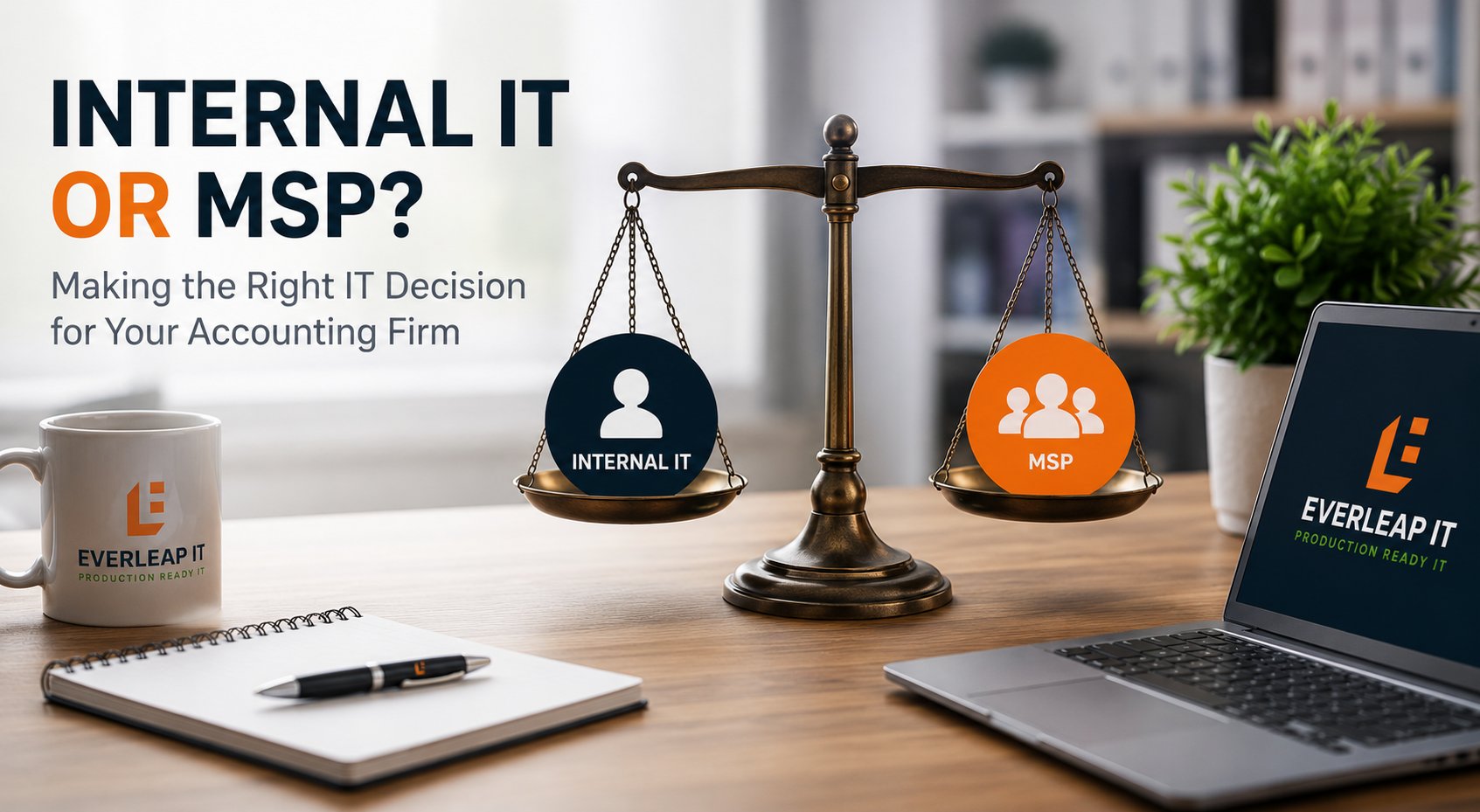
For most 5-25 employee accounting firms, the IT decision is not simply whether an internal employee or a managed service provider costs less. Leadership should compare at least six factors: required expertise, coverage and availability, cybersecurity, strategic planning, business continuity, and total cost.
A dedicated internal IT professional can provide valuable familiarity and direct access, particularly as an organization becomes larger or more complex. An MSP can provide a broader team of specialists, standardized processes, monitoring, security capabilities, and coverage without relying on one individual.
For some firms, the right answer may even be a hybrid model. The objective is to choose an IT operating model that matches the firm's size, complexity, risk, and dependence on technology.
Why This Decision Matters for Accounting Firms
Technology in an accounting firm is no longer limited to fixing computers and installing software. A modern IT environment may include:
- Microsoft 365
- Tax and accounting applications
- Document management
- Client portals
- Servers and cloud infrastructure
- Firewalls and networks
- Remote access
- Backup and disaster recovery
- Cybersecurity
- Identity management
- Employee onboarding and offboarding
- Hardware lifecycle management
- Vendor coordination
- Strategic technology planning
Someone needs to take responsibility for keeping these systems reliable, secure, documented, and aligned with the business. For a smaller firm, hiring one internal IT employee can appear to provide that ownership. But leadership should ask an important question:
Does the firm need one IT person, or does it need access to multiple IT capabilities?
A six-part framework can help answer that question.
1. Compare the Breadth of Expertise the Firm Needs
A capable IT professional may be able to handle a wide range of responsibilities. But modern business technology increasingly requires expertise across several disciplines. An accounting firm may need knowledge of:
- Microsoft 365 administration
- Microsoft Entra ID
- Endpoint management
- Networking
- Firewalls
- Cybersecurity
- Backup and disaster recovery
- Servers
- Cloud platforms
- Tax applications
- Hardware lifecycle
- Vendor management
It is difficult for any one person to be equally experienced in every area. That does not make an internal IT professional ineffective. It simply means leadership should understand where additional expertise may be required.
The Internal IT Model
An internal IT employee can develop deep familiarity with:
- The firm's employees
- Its applications
- Its workflows
- Its technology history
- Its business priorities
- Its recurring problems
That institutional knowledge can be valuable. An internal employee may also be immediately accessible for onsite needs and can participate closely in day-to-day business operations.
The MSP Model
A managed IT provider typically distributes responsibilities across a team. Instead of expecting one person to handle every technology issue, the firm may have access to different people for:
- Help desk support
- Microsoft 365
- Networking
- Cybersecurity
- Backup and recovery
- Infrastructure
- Projects
- Strategic planning
Firms considering outsourcing should also understand what to expect from a managed IT provider, including both day-to-day support and the proactive responsibilities the provider will assume. The relevant question is therefore not simply: How many technicians does the MSP have?
It is: Does the provider have the expertise our environment actually requires, and can we access that expertise when needed?
2. Evaluate Coverage and the Risk of Depending on One Person
Accounting firms operate throughout the year, but technology dependence becomes especially visible during tax season and other deadline-driven periods. If the firm relies on one internal IT person, leadership should consider what happens when that person is:
- Sick
- On vacation
- Unavailable after hours
- Already handling another critical issue
- No longer employed by the firm
This is sometimes referred to as key-person dependency. The issue is not the quality of the employee. The issue is that a single individual has finite availability.
What Happens During Two Problems at Once?
Consider a simple scenario. At 9:00 AM, several employees cannot access a tax application. At the same time, another employee reports a suspicious Microsoft 365 login. Both issues may deserve immediate attention. One IT employee can work only one problem at a time. An MSP with appropriate staffing may be able to assign different resources to each issue. That difference becomes more important as the firm's technology environment and dependence on uptime grow.
Coverage Should Be Evaluated, Not Assumed
Outsourcing does not automatically guarantee better coverage. An accounting firm should still understand:
- Support hours
- After-hours procedures
- Escalation processes
- Onsite availability
- Critical-incident handling
- Staffing depth
The goal is to determine whether the support model provides enough coverage for the firm's operational requirements.
3. Compare Cybersecurity Capabilities
Cybersecurity is one of the areas where the IT role has expanded significantly. An accounting firm may need ongoing management of:
- Multi-Factor Authentication
- Microsoft Entra ID
- Conditional Access
- Endpoint protection
- Email security
- Administrative privileges
- Encryption
- Security awareness
- Patch management
- Backup security
- Vulnerability remediation
- Security monitoring
One internal IT employee may be capable of managing many of these cybersecurity controls. The question is whether the firm has the time, expertise, processes, and independent oversight needed to manage them consistently.
Who Reviews the Person Managing Security?
This is an important governance question. If one person manages:
- Administrative accounts
- Security policies
- Microsoft 365
- Backups
- Endpoint security
- Network security
Who verifies that those controls are configured appropriately? A team-based approach can provide additional review and separation of responsibilities. That does not mean an MSP automatically provides strong cybersecurity. Firms should evaluate the provider's actual security practices rather than assuming "managed IT" and "managed security" are the same thing.
4. Determine Who Will Own Proactive Planning
Day-to-day support can consume a surprising amount of time. When employees need help with passwords, printers, applications, laptops, email, Microsoft 365, and other issues, an internal IT employee may spend much of the day responding to immediate needs. That can make longer-term work difficult. Yet an accounting firm's technology also needs ongoing planning. Examples include:
- Computer replacement
- Server lifecycle
- Firewall lifecycle
- Software end-of-support
- Microsoft 365 licensing
- Backup capacity
- Recovery testing
- Security improvements
- Internet redundancy
- Technology budgeting
- Application changes
Leadership should therefore ask: Who is responsible for looking 12, 24, and 36 months ahead?
Support and Strategy Are Different Responsibilities
Being excellent at resolving tickets does not automatically mean someone has enough time to build and maintain a three-year IT roadmap that addresses lifecycle, security, capacity, budgeting, and anticipated business changes. Likewise, a strategic advisor may not be the right person to troubleshoot an employee's printer. A mature IT operating model should account for both. With an internal model, that may mean supplementing the IT employee with outside specialists or consultants. With an MSP, leadership should confirm that strategic planning is actually part of the service and not simply assume that it is.
5. Consider Business Continuity and Institutional Knowledge
A firm's IT knowledge should not exist only in one person's memory. Whether IT is managed internally or outsourced, the firm should maintain appropriate IT documentation for the systems, accounts, vendors, configurations, and procedures required to operate its technology. That may include:
- Network configurations
- Administrative access
- Microsoft 365
- Vendors
- Domains and DNS
- Backup systems
- Security configurations
- Hardware inventories
- Application dependencies
- Recovery procedures
- Licensing
- Technology standards
This becomes especially important when someone leaves.
What If the IT Person Leaves?
Suppose the firm's only IT employee resigns with two weeks' notice. Leadership may suddenly need to determine:
- Where are administrative passwords stored?
- Who controls the firewall?
- Who has Microsoft 365 Global Administrator access?
- How do backups work?
- What systems are approaching renewal?
- Which vendors should be contacted?
- What projects are currently underway?
- Where is the network documentation?
If the answers exist primarily in one person's head, the firm has operational risk. A well-managed MSP should face the same documentation expectation. The firm should not become dependent on a particular MSP technician either. The goal is organizational knowledge rather than individual knowledge.
6. Compare Total Cost, Not Just Salary Versus Monthly MSP Fee
Cost comparisons between internal IT and outsourced IT are often oversimplified. A firm might compare: Internal IT salary versus monthly MSP fee. That does not necessarily represent the total cost of either model.
Internal IT Costs May Include
In addition to compensation, an internal model may involve:
- Payroll taxes
- Benefits
- Recruiting
- Training
- Certifications
- Paid time off
- Cybersecurity products
- Monitoring platforms
- Backup tools
- Remote-support tools
- Documentation platforms
- Outside consultants
- After-hours coverage
MSP Costs May Include
Depending on the agreement:
- Per-user or fixed monthly fees
- Onboarding
- Security tools
- Backup services
- Microsoft licensing
- Projects
- Hardware
- After-hours work
- Specialized consulting
The scope varies considerably between providers. Leadership should therefore compare annual total cost and capability, not one salary against one monthly invoice. For firms evaluating the outsourced model, understanding the factors that influence managed IT costs for accounting firms can help leadership build a more accurate comparison.
When Does an Internal IT Person Make Sense?
There are situations where dedicated internal IT can be a strong model. It may make sense when:
- The organization is large enough to justify dedicated resources.
- Technology needs are unusually specialized.
- The business requires substantial daily onsite IT involvement.
- Internal applications require dedicated technical knowledge.
- The organization is building a larger internal IT department.
- Leadership wants direct IT staff integrated into business operations.
The key word is department. As technology complexity increases, organizations often move beyond one generalist and begin building specialized roles. That can provide both internal business knowledge and broader technical depth. For a smaller accounting firm, however, building an entire IT department may not be economically practical.
When Does Outsourcing IT to an MSP Make Sense?
An MSP may be appropriate when the firm wants:
- Access to multiple technical disciplines
- Broader support coverage
- Standardized processes
- Proactive monitoring
- Cybersecurity management
- Documentation
- Backup and recovery oversight
- Lifecycle planning
- Strategic technology guidance
- More predictable IT operating costs
This can be particularly useful for small and midsize firms that depend heavily on technology but do not require enough daily work to justify building a complete internal IT team. However, outsourcing does not eliminate the firm's responsibility for technology. Leadership still needs to participate in:
- Business decisions
- Security decisions
- Budgeting
- Risk acceptance
- Application selection
- Strategic priorities
The MSP should provide expertise and operational capability, but the business still owns the business decisions.
What About a Hybrid IT Model?
The choice does not always have to be internal IT or MSP. Some organizations use both. For example, an internal IT person might handle:
- Day-to-day business coordination
- Application knowledge
- Employee needs
- Internal projects
while an MSP provides:
- Help desk overflow
- Cybersecurity
- Network management
- Microsoft 365 expertise
- Backup and recovery
- Monitoring
- After-hours coverage
- Specialized projects
This can reduce key-person dependency while preserving the benefits of an internal technology resource.
Define Responsibilities Carefully
A hybrid model works best when responsibilities are explicit. Otherwise, problems can fall into the gap between "we thought internal IT was handling that" and "we thought the MSP was handling that." If an outside provider is involved, the managed IT services agreement should clearly define which responsibilities belong to the provider and which remain with the firm's internal team.
Example: A 20-Person Accounting Firm Evaluating Its IT Model
Consider a 20-person accounting firm with one internal IT employee. The employee knows the firm well and provides good support. As the environment grows, however, the responsibilities now include:
- 20 employee computers
- Microsoft 365
- Entra ID
- A firewall and network
- Several cloud applications
- A local server
- Backup and recovery
- Endpoint security
- Employee onboarding and offboarding
- Vendor coordination
During tax season, the employee spends most of the workday responding to immediate requests. Lifecycle planning and security projects are frequently postponed. The firm initially considers replacing the employee with an MSP. After reviewing the situation, leadership realizes the real question is different:
Which responsibilities should remain internal, and which require broader outside resources?
The firm might choose full outsourcing. It might retain the employee and use an MSP for security, infrastructure, monitoring, and escalation. Or, as the firm grows, it might build a larger internal department. The useful outcome is not automatically "outsource." It is matching resources and responsibilities to business requirements.
A Six-Question Decision Framework
Accounting-firm leadership can begin with these questions:
- How many different technical disciplines does our environment require?
- What happens when our primary IT person is unavailable?
- Who independently reviews cybersecurity configurations and administrative access?
- Who is responsible for planning 12-36 months ahead?
- Is critical technology knowledge documented and accessible to the firm?
- What is the total annual cost of providing the required capabilities under each model?
If those questions expose significant gaps, the current IT model may need to evolve.
The Better Question: Who Is Operating the Technology?
The internal-versus-outsourced debate can become too focused on staffing.
At Everleap IT, we believe the more important question is:
Who is responsible for operating the firm's business-critical technology?
Operating technology means more than responding when something breaks.
It includes:
- Monitoring
- Maintenance
- Cybersecurity
- Documentation
- Recovery readiness
- Lifecycle management
- Capacity planning
- Strategic planning
- Continuous improvement
Those responsibilities exist whether the people performing them are employees, an MSP, or a combination of both. The firm's IT model should ensure those responsibilities have clear owners.
How Everleap IT Approaches Outsourced and Co-Managed IT
Our approach has been shaped by more than 20 years of operating production hosting environments, where reliability depends on teams, documented processes, monitoring, security, escalation, and operational discipline rather than one person's institutional knowledge.
For accounting firms, those principles can be applied through:
- Proactive monitoring
- Help desk support
- Microsoft 365 administration
- Cybersecurity
- Backup and recovery
- Documentation
- Hardware lifecycle management
- Vendor coordination
- Quarterly technology reviews
- Strategic technology planning
- Production Readiness assessments
The objective is not to convince every organization that internal IT is wrong. It is to determine whether the firm's current resources provide the coverage, expertise, security, planning, and operational discipline its technology requires.
Should Your Accounting Firm Hire IT or Outsource It?
For a smaller accounting firm, start by evaluating the work rather than the job title. Document the technology responsibilities the business needs. Then determine:
Can one internal person realistically provide those capabilities?
Would an MSP provide the appropriate expertise and coverage?
Would a hybrid model provide a better combination?
The right answer may change as the firm grows.
Everleap IT helps accounting firms throughout California's Inland Empire, including Chino, Claremont, Ontario, Rancho Cucamonga, Upland and nearby communities, operate business-critical technology through proactive monitoring, cybersecurity, documentation, lifecycle management, recovery readiness, strategic planning, and Production Readiness assessments.
If your firm is evaluating whether to hire internal IT, outsource technology management, or use a combination of both, a technology assessment can help identify the responsibilities, risks, and capabilities the business actually needs. Contact us to discuss your IT needs and schedule a technology assessment.