
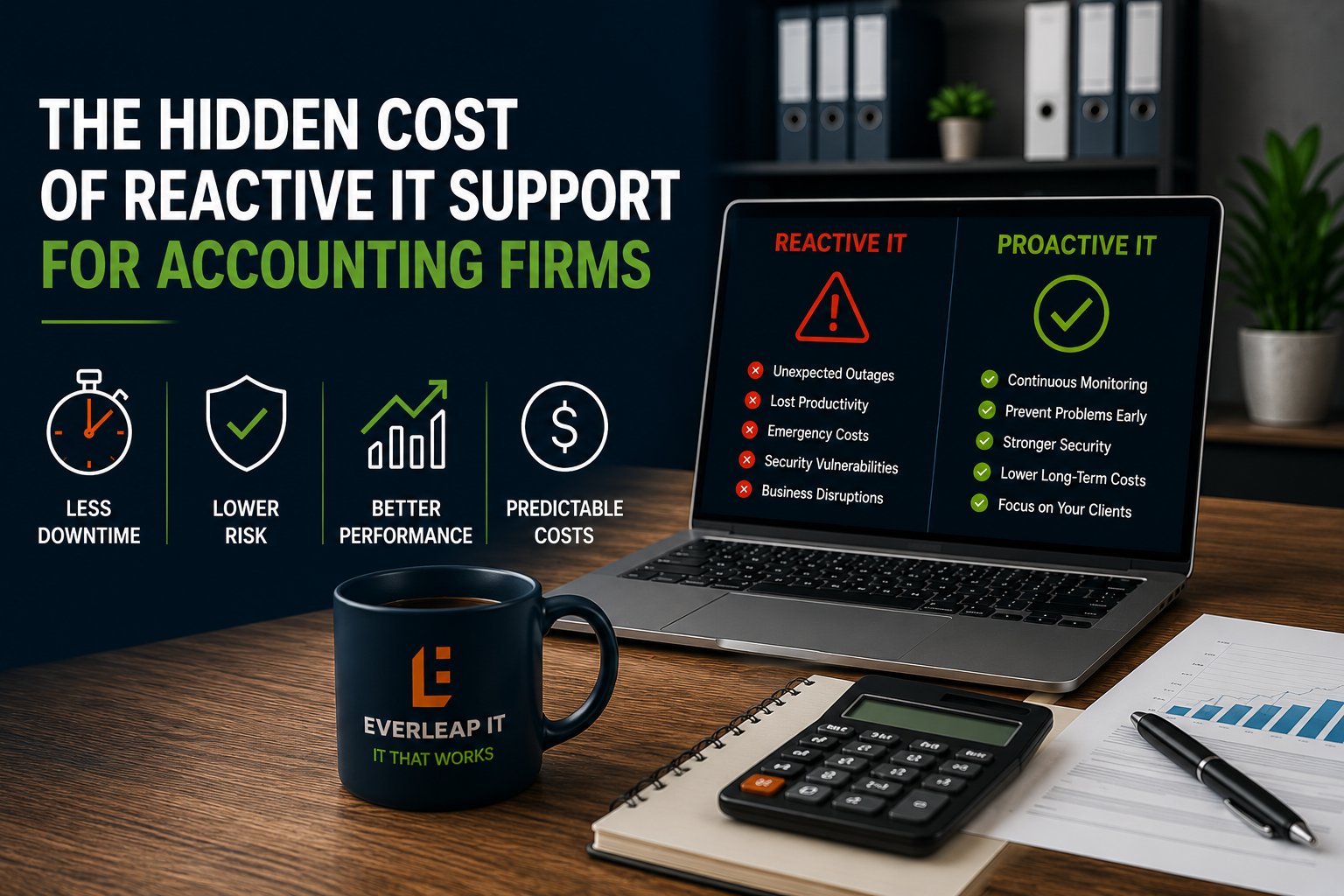
Many accounting firms believe their technology is working well because employees can access email, open tax software, and print documents without major issues.
Then something unexpected happens.
A server fails during tax season.
Microsoft 365 authentication stops working.
A firewall reaches the end of its support lifecycle.
A laptop crashes the morning of an important client meeting.
The internet goes down during payroll processing.
Suddenly, technology becomes the firm’s highest priority.
The problem is not the individual incident.
The problem is that many organizations manage technology only after something breaks.
Reactive IT support may appear less expensive in the short term, but over time it often creates higher costs, greater operational risk, and more business disruption than a proactive approach.
For accounting firms that rely on technology every day, the true cost of reactive IT extends far beyond repair bills.
What Is Reactive IT?
Reactive IT is exactly what it sounds like.
Technology issues are addressed only after they begin affecting employees or clients.
Examples include:
- Replacing failed computers
- Fixing server outages
- Responding to ransomware attacks
- Troubleshooting slow networks
- Recovering deleted files
- Repairing failed hardware
These activities are necessary.
However, if they represent the majority of your IT strategy, your technology environment is constantly responding to yesterday’s problems instead of preparing for tomorrow’s demands.
The Costs You Don’t See on an Invoice
Most firms evaluate IT based on monthly service fees.
The larger costs often never appear on an invoice.
Instead, they show up in lost productivity, missed opportunities, and unnecessary operational risk.
Lost Employee Productivity
Technology problems interrupt concentration.
A five-minute interruption may not seem significant.
Multiply that across multiple employees, several times each week, and the impact becomes substantial.
Examples include:
- Slow computers
- Wi-Fi interruptions
- Printer failures
- Software crashes
- Login issues
- Microsoft 365 problems
Employees cannot bill clients while waiting for technology to recover.
Emergency Projects Cost More
Planned technology projects allow organizations to budget appropriately, compare options, and schedule implementation at convenient times.
Emergency replacements rarely provide those advantages.
Examples include:
- Overnight server replacement
- Emergency firewall purchases
- Rush hardware orders
- After-hours implementation
- Unexpected consulting time
Planning almost always costs less than reacting.
Deferred Maintenance Becomes Operational Debt
Accounting firms understand financial debt.
Technology environments accumulate operational debt in much the same way.
Examples include:
- Unsupported operating systems
- Aging firewalls
- Expired warranties
- Incomplete documentation
- Delayed hardware replacement
- Unpatched software
- Legacy applications
A planned hardware replacement lifecycle helps firms address aging computers, servers, and other infrastructure before equipment failure turns a predictable expense into an emergency.
Each individual issue may appear manageable.
Together, they increase operational risk and make future improvements more expensive.
Ignoring maintenance today often creates larger projects tomorrow.
Security Risks Continue to Grow
Cybersecurity is not a one-time project.
Every month brings:
- New vulnerabilities
- Software updates
- Identity threats
- Phishing campaigns
- Ransomware variants
Organizations that delay routine maintenance often discover security weaknesses only after an incident occurs. Implementing and continuously maintaining proactive cybersecurity controls helps reduce that risk before a security issue becomes a business disruption.
Business Planning Becomes More Difficult
Unexpected technology failures create unpredictable budgets.
Instead of planning technology investments over several years, businesses find themselves making emergency purchasing decisions.
Examples include:
- Replacing multiple laptops unexpectedly
- Upgrading networking equipment after failures
- Purchasing software without strategic planning
- Implementing security improvements because of insurance deadlines
Predictable budgeting becomes much more difficult when technology decisions are driven by emergencies.
Clients Notice More Than You Think
Accounting firms build their reputation on professionalism and reliability.
Technology problems can affect that perception.
Examples include:
- Delayed tax filings
- Missed meetings
- Slow response times
- Interrupted video conferences
- Client portal outages
- Email disruptions
Clients may never know why an issue occurred.
They simply remember that it affected their experience.
Reliable technology supports client confidence.
Reactive IT Creates Technology Debt
Technology debt develops gradually.
No single issue creates a crisis.
Instead, small decisions accumulate over time.
Examples include:
“We’ll replace those laptops next year.”
“We’ll review backups later.”
“The firewall is still working.”
“We’ll document that after busy season.”
“We’ll upgrade Microsoft 365 another time.”
Eventually those postponed decisions begin affecting one another.
The environment becomes harder to manage, less secure, and more expensive to maintain.
What Proactive IT Looks Like
Proactive IT focuses on preventing problems rather than simply responding to them. That requires treating business-critical technology as an environment that must be continuously operated, monitored, maintained, and improved, rather than simply supported when something breaks.
Examples include:
- Continuous monitoring
- Hardware lifecycle planning
- Security reviews
- Backup testing
- Microsoft 365 optimization
- Documentation
- Capacity planning
- Quarterly technology reviews
Instead of reacting to failures, organizations reduce the likelihood of those failures occurring in the first place.
Production Readiness Reduces Operational Risk
One of the core principles of Everleap IT's Production Readiness Framework is that technology should be continuously evaluated, monitored, and improved.
Rather than asking:
“What broke?”
We ask:
“What could become tomorrow’s problem?”
That shift changes how technology investments are prioritized.
It allows organizations to improve reliability while reducing operational surprises.
Production Ready environments are designed to remain healthy through continuous operational management rather than emergency repairs.
How Everleap IT Helps Clients Move Beyond Reactive IT
Our approach begins with understanding how technology supports your business.
From there, we focus on reducing operational risk through:
- Continuous monitoring
- Strategic planning
- Hardware lifecycle management
- Microsoft 365 optimization
- Identity security
- Backup verification
- Infrastructure documentation
- Capacity planning
- Quarterly technology reviews
Our experience operating production hosting environments for more than twenty years has taught us that reliability comes from discipline, consistency, and continuous improvement.
Those same principles guide every client relationship.
The Most Expensive Technology Problems Are Often the Ones You Never Planned For
Reactive IT is not simply about fixing computers after they fail.
It is about allowing operational risk to accumulate until business disruption becomes unavoidable.
Accounting firms that plan technology proactively often experience:
- More reliable systems
- Stronger cybersecurity
- Better employee productivity
- Predictable technology budgets
- Greater business resilience
Technology should support your firm’s growth, not become an obstacle to it.
Ready to Reduce Technology Debt?
Everleap IT helps accounting firms throughout California’s Inland Empire, including Rancho Cucamonga, Upland, Ontario and nearby communities, replace reactive technology management with a proactive operational strategy. Through continuous monitoring, strategic planning, lifecycle management, cybersecurity, and Production Readiness assessments, we help firms reduce operational risk before it becomes a business disruption.
If you’re ready to move beyond emergency IT and build a more resilient technology environment, we’d be happy to help. Book a 15 minute consultation appointment today.