For many businesses, IT has traditionally been viewed as a reactive service.
Something breaks.
An employee calls the help desk.
A technician fixes the problem.
Business continues.
While that approach may have worked years ago, today’s accounting firms depend on technology in ways that make reactive support increasingly risky. Email, tax software, Microsoft 365, document management systems, cloud applications, remote access, and cybersecurity all play a role in serving clients and meeting deadlines.
When technology becomes business critical, simply fixing problems after they occur is no longer enough.
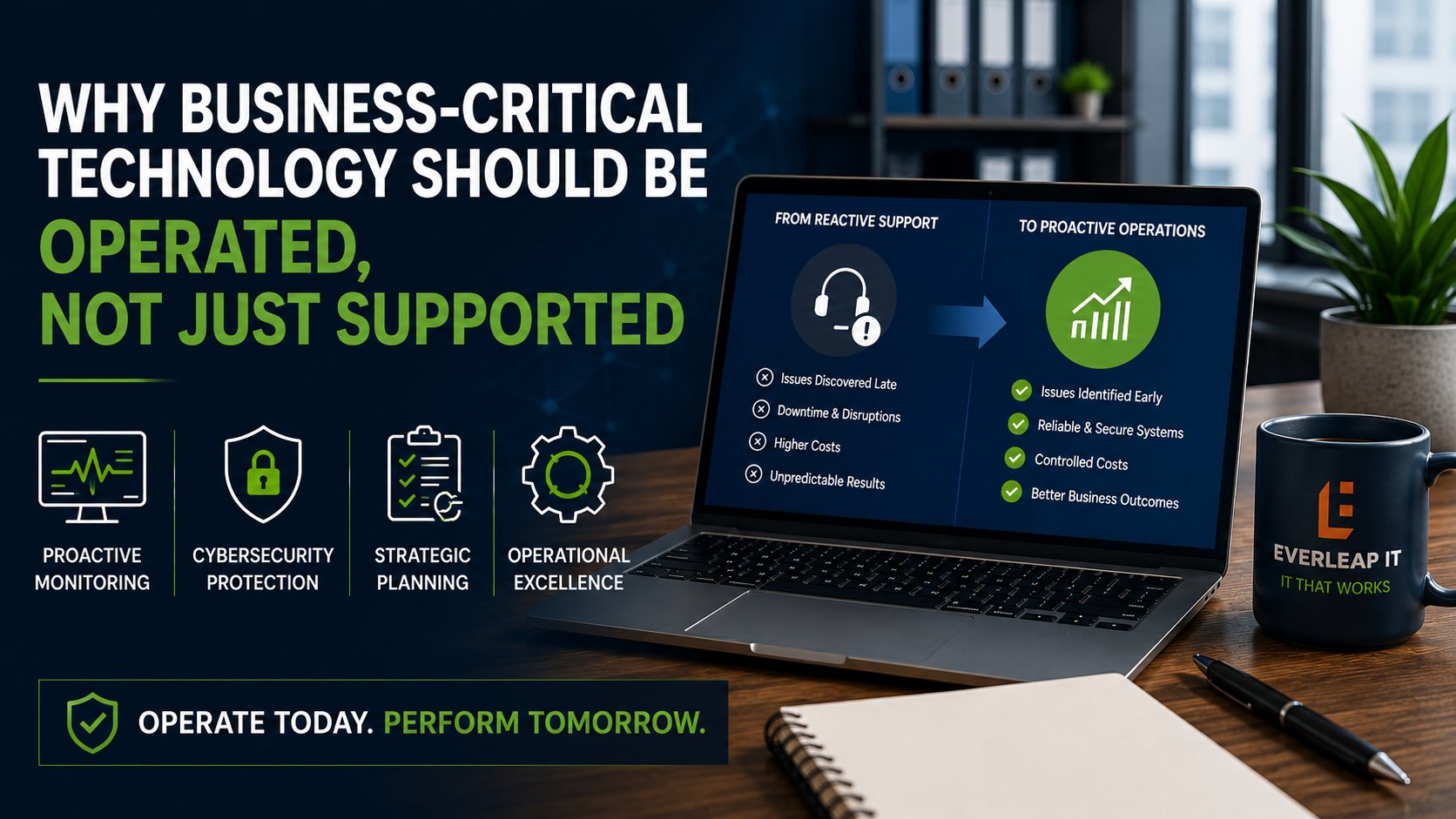
Business-critical technology must be operated, not just supported.
At Everleap IT, this philosophy has been shaped by more than twenty years of managing production hosting environments where uptime, security, monitoring, and operational discipline are essential every day. That experience influences how we help accounting firms build reliable, secure, and resilient technology environments that support long-term business success.
The Difference Between Supporting Technology and Operating Technology
Support and operations are often used interchangeably, but they represent two very different approaches.
Support is reactive.
Operations are proactive.
A support-focused IT provider primarily responds to issues after users experience problems.
An operations-focused technology partner works continuously behind the scenes to reduce the likelihood of those problems occurring in the first place.
Both approaches have value.
The difference is where the majority of effort is invested.
Understanding what to expect from a Managed IT provider can help accounting firms evaluate whether their current relationship is primarily focused on responding to incidents or proactively improving the technology environment.
Technology Support Focuses on Incidents
Typical support activities include:
- Resolving help desk tickets
- Resetting passwords
- Troubleshooting application issues
- Replacing failed hardware
- Assisting employees with software questions
These services are important, but they generally occur after business has already been interrupted.
Technology Operations Focuses on Reliability
Operational IT emphasizes:
- Continuous monitoring
- Capacity planning
- Preventive maintenance
- Security management
- Backup verification
- Infrastructure documentation
- Hardware lifecycle planning
- Strategic technology reviews
- Continuous improvement
The objective is to prevent interruptions whenever possible.
Why This Difference Matters for Accounting Firms
Accounting firms experience predictable periods of intense activity.
During tax season, month-end close, payroll processing, and year-end reporting, even small technology issues can have significant consequences.
For example:
A failed backup may go unnoticed for weeks.
A storage device may be approaching capacity.
A firewall warranty may have expired.
Microsoft 365 licenses may not be sufficient for seasonal employees.
A server may require firmware updates.
None of these issues immediately generate a help desk ticket.
However, each one increases operational risk.
Technology operations identify these conditions before they become business disruptions.
Reactive IT Creates Hidden Costs
Many organizations evaluate IT providers based on response times.
Fast response is important.
However, responding quickly to preventable problems is still responding to preventable problems.
Reactive IT often leads to:
- Increased downtime
- More emergency projects
- Unexpected hardware failures
- Higher support costs
- Inconsistent security
- Deferred maintenance
- Budget surprises
- Employee frustration
Over time, these hidden costs frequently exceed the investment required for proactive operational management.
Operational IT Is Built on Continuous Improvement
Production environments rarely remain unchanged.
Applications evolve.
Cyber threats change.
Business requirements grow.
Technology operations recognize that maintaining a healthy environment requires continuous improvement rather than occasional repairs.
Examples include:
- Reviewing Microsoft 365 security settings
- Monitoring infrastructure performance
- Testing backup recovery
- Updating documentation
- Replacing aging hardware
- Improving identity security
- Refining disaster recovery procedures
Small improvements performed consistently often produce better long-term results than large emergency projects.
The Seven Characteristics of an Operationally Mature Technology Environment
At Everleap IT, we evaluate business-critical technology through the lens of operational maturity.
While every organization is unique, mature environments typically share several characteristics.
1. Continuous Monitoring
Systems are monitored around the clock to identify developing issues before users notice them.
Monitoring includes:
- Infrastructure health
- Hardware status
- Backup success
- Microsoft 365 services
- Capacity trends
- Security alerts
2. Standardization
Standardized environments are easier to support, secure, and scale.
Examples include:
- Consistent hardware
- Standard Microsoft 365 configurations
- Common security policies
- Standard software deployments
Consistency reduces complexity.
3. Documentation
Accurate documentation supports faster problem resolution and better long-term planning.
Documentation should include:
- Network diagrams
- Hardware inventory
- Software inventory
- Vendor contacts
- Administrative procedures
- Recovery documentation
4. Lifecycle Management
Technology should be replaced according to business needs, manufacturer support, and operational risk rather than waiting for failures. A planned hardware lifecycle strategy improves reliability while creating more predictable technology budgets.
5. Security Integration
Security should be integrated into daily operations rather than treated as a separate project.
Examples include:
- Multi-Factor Authentication
- Identity management
- Endpoint protection
- Email security
- Vulnerability management
- Security monitoring
6. Recovery Readiness
Backups alone are not enough. Business continuity and disaster recovery planning help define not only how technology will be restored, but how the firm will continue serving clients while recovery is taking place.
Operational maturity requires:
- Restore testing
- Disaster recovery procedures
- Business continuity planning
- Recovery documentation
- Clearly defined recovery priorities
7. Strategic Planning
Technology investments should support business objectives.
Regular planning helps organizations:
- Prioritize projects
- Forecast budgets
- Improve operational efficiency
- Reduce long-term risk
- Support future growth
A three-year IT roadmap can turn these priorities into a structured plan, helping leadership coordinate technology investments with budgets, business objectives, and future growth.
Technology Operations Improve Business Outcomes
When technology is operated proactively, organizations often experience benefits that extend beyond the IT department.
These include:
- Fewer unexpected interruptions
- Greater employee productivity
- Improved cybersecurity
- Better client experiences
- More predictable technology budgets
- Increased confidence in business continuity
- Reduced operational risk
Together, these seven characteristics contribute to what we call Production Readiness, a technology environment designed to support the business reliably during both normal operations and periods of peak demand. The result is a technology environment that supports the business rather than distracting from it.
How This Philosophy Shapes Everleap IT’s Approach
Our operational mindset comes from decades of managing production hosting environments where availability, reliability, and security are expected every hour of every day.
That experience influences how we approach every client relationship.
Rather than focusing solely on resolving support tickets, we continuously evaluate the overall health of each technology environment.
That includes:
- Infrastructure monitoring
- Microsoft 365 optimization
- Identity security
- Backup verification
- Hardware lifecycle planning
- Documentation
- Capacity planning
- Strategic technology reviews
Our objective is simple.
Help clients reduce operational risk while creating technology environments that are secure, resilient, and prepared for future growth.
Technology Should Be Managed Like Every Other Critical Business Function
Accounting firms routinely monitor financial performance, client service, regulatory requirements, and operational processes.
Technology deserves the same level of discipline.
Business-critical systems should be continuously monitored, maintained, documented, reviewed, and improved rather than simply repaired after problems occur.
The firms that embrace operational excellence often experience stronger security, greater reliability, improved productivity, and fewer unexpected disruptions.
Technology becomes a strategic business asset instead of a recurring source of uncertainty.
Ready to Move Beyond Reactive IT?
Everleap IT helps accounting firms throughout California’s Inland Empire, including Rancho Cucamonga, Ontario, Chino and nearby communities, operate business-critical technology through proactive monitoring, cybersecurity, strategic planning, lifecycle management, and operational excellence.
If you’re ready to move beyond simply fixing problems and begin building a more resilient technology environment, schedule an Assessment. We’ll evaluate your current environment, identify opportunities for improvement, and develop a roadmap that helps technology support your business instead of slowing it down. Book an appointment today to discuss your IT situation and schedule a technology assessment.